How We Rewire a Working Farm Without Shutting the Farm Down
The farm doesn't stop for the rewire, so the rewire works around the farm.
September 10, 2026 · 3 min read
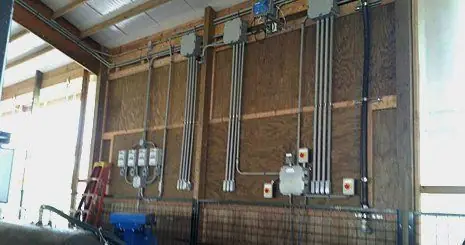
A dairy or livestock operation doesn't get a week off while an electrician rewires the barn. Cows still need to be milked twice a day, feed still has to move on schedule, and ventilation fans can't just go dark for an afternoon in July. Every farm rewire we do gets planned around that reality first and the electrical work second.
Why a full rewire and a running farm are hard to schedule at the same time
The wiring in an older farm building is often original to a structure built decades before the equipment running through it today existed. Robotic milking systems, automated feeders and larger ventilation loads all draw more, and more consistently, than the wiring was ever designed for. The fix is a real rewire, not a patch, but a barn full of livestock on a milking schedule can't simply go without power while that happens.
How we phase the work
We break the job into sections that match how the barn is actually used, rather than treating it as one continuous shutdown. That usually means working through one zone at a time, a specific stall row, a feed area, a section of the parlor, while the rest of the barn keeps running on its existing wiring until its turn comes. It takes longer in total than gutting the whole building at once would, but it means the farm never actually stops operating during the project.
- Map the barn into zones based on how milking, feeding and ventilation actually flow through the day
- Work one zone at a time, keeping the rest of the barn on live power throughout
- Schedule the most disruptive work, trenching and panel changeovers, around chore times, not the other way around
- Test and energize each completed zone before moving to the next
What stays live and what doesn't
Within any zone we're working on, we plan specifically around milking times and, depending on the season, harvest schedules, so the actual power interruption to any one circuit is as short as we can make it and happens when it costs the farm the least. Ventilation is usually the circuit we're most careful with in warm weather, since livestock can be affected by heat stress faster than most other problems on a farm show up.
We carry our own trenchers and underground locating equipment for the runs between buildings, which matters on a working farm because it means we're not waiting on rented equipment or guessing at what's already buried between the barn and the shop.
Wrapping up around milking and harvest
The last stretch of any farm rewire is tying the new work back into the panel and testing everything as a whole system, which we schedule for a window that doesn't collide with milking or, if it's that time of year, harvest. Bauer Electric has been doing farm rewiring out of the same Waupaca shop since 1957, and the reason we still plan this way is simple: a farm's schedule doesn't move for an electrical project, so the project has to move for the farm.
This same phased approach carries over into robotic farm installations, which is a newer part of the work but runs on the same logic. A robotic milking system needs clean, dedicated circuits and reliable ventilation and control wiring around it, and it's usually going into a barn that's still operating on the older wiring everywhere else. We treat the robot's zone as its own phase, wired and tested on its own, rather than folding it into a general rewire that touches the whole building at once.
Communication matters as much as the wiring itself on these jobs. We walk the schedule with whoever runs the farm before we start, not just once but at the start of each phase, because chore times shift with the season and a plan made in April doesn't always hold in August. A farm rewire that respects that is a longer project on paper and a much less disruptive one in practice.
Bauer Electric Inc, (715) 258-2848
Call (715) 258-2848