Home & Farm
Wiring for the house and the barn, from the same Waupaca shop
New construction, rewiring and panel upgrades for houses across Central Wisconsin, and the farm-specific work that comes with it: stray voltage testing, live-farm rewiring, standby generators and the wiring a robotic barn needs to run.
Chapter 01
Stray voltage: what it does to a milking herd and how we find it
Stray voltage is a small electrical potential, sometimes only a volt or two, that a cow can feel through her hooves at a waterer, a stall divider or the milking parlor floor. Cattle are far more sensitive to it than people are. A herd that has picked up stray voltage backs off feed and water without any obvious cause, milk production slides, and somatic cell counts can climb before an owner ever thinks to call an electrician instead of a vet.
We track it with a voltmeter and clamp-on ammeter at the suspected contact points, then work the circuit back from the barn to the panel and, where the source sits outside the building, to the neutral-to-ground bond and the service itself. On an older Central Wisconsin dairy that can mean an aging sub-panel, a corroded ground rod, or wiring that was added building by building over fifty years without ever being tied back to a single, correctly bonded system. We find the actual source and correct it, not just isolate the symptom with a temporary bond.
This is one of the reasons a farm call and a house call are not the same job even when the panel looks identical. A residential rewire has to satisfy a family and an inspector. A dairy barn's wiring has to satisfy that too, plus a herd that will tell you, in lost production, if something was missed.
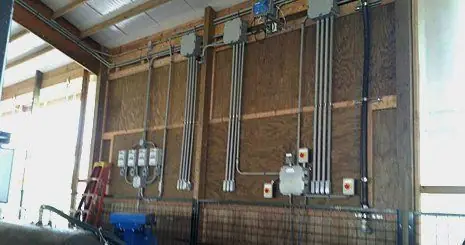
Conduit runs, panels and disconnects mounted on the wood-frame wall of an agricultural building
Rewiring a working farm without shutting the farm down
A farm rewire almost never gets the luxury of an empty building. Cows still need to be milked twice a day, feed still needs to move, and a robotic system or a bulk tank cannot sit dead for a week while a crew works. We stage the job circuit by circuit and building by building, so the barn keeps running while we're in it, temporary feeds are set up cleanly rather than run off an extension cord across a walkway, and the farm's actual schedule, not ours, decides when a given circuit goes cold.
The same staging discipline applies to a house that's occupied during a remodel or a panel upgrade. New home construction wiring is the more straightforward version of this work, since it's usually rough-in before drywall. A remodel or an old farmhouse rewire is closer to the barn problem: working around a family's routine, opening walls in the right order, and running new circuits before the old ones come out so nobody loses power overnight.
Panel upgrades and replacements, troubleshooting, and general repair and maintenance make up most of the day-to-day residential side of this. Outdoor security lighting around a farmyard or a house is a common add-on to that same visit, since the trencher and the ladder are already on site.
Chapter 03
Whole-house and whole-farm backup generators (Generac)
Central Wisconsin loses power in an ice storm the way other places lose it in a heat wave, and a farm loses more than comfort when that happens. A dairy operation with an automatic milking system or a bulk tank running can't wait out a multi-day outage, and a house with a well pump goes dry the same afternoon the power does. We install Generac standby generator systems sized to carry a house, or an entire farm's critical loads, through an outage automatically, transfer switch included, so the system starts itself rather than waiting on somebody to get to a portable unit in the dark.
Sizing is the part that actually matters here. A generator picked to cover a house's lighting and a refrigerator is a different machine from one that has to start a well pump, a grain auger and a milking system at the same time, and getting that wrong either wastes money on an oversized unit or leaves a farm short exactly when it can't afford to be. We work from the actual panel and the actual equipment on the property, not a size chart.
Robotic farm installations and the wiring a robot barn actually needs
A robotic milking or feeding system asks more of a barn's electrical system than the equipment it's replacing. It needs clean, stable power, because a voltage sag that a light fixture never notices can fault a robot's control system mid-cycle. It needs dedicated circuits sized correctly rather than shared with whatever else happens to be on that leg, and it needs backup power that's actually sized for the robot's full running load, not just enough to keep the barn lit while a farmer waits out the storm.
We've wired robotic farm installations from the ground up on new builds and retrofitted the power into existing barns that were never designed around one, which is the more common call. That second kind of job is really the rewiring and generator work above, applied to equipment that has far less tolerance for a bad connection than the barn it's sitting in.
Whatever the entry point, whether it starts as a stray voltage call, a panel that's due for an upgrade, or a new robot going into an old barn, it comes out of the same shop on County Highway QQ that's been doing this work since 1957. Call (715) 258-2848 and describe what you're seeing; we'll tell you honestly whether it's a quick fix or a bigger rewire.
Bauer Electric — Licensed and insured electrical contractors. Call (715) 258-2848.