Shop Floor & Storefront
Plant power and storefront wiring, out of the same Waupaca shop
New construction, maintenance and troubleshooting for shops and offices across Central Wisconsin, plus the plant-floor work that doesn't show up on a residential call: drive motor tuning, PLC configuration, meter calibration and lighting retrofits that clear an inspection instead of stalling on one.
Chapter 01
Drive motor tuning and PLC controller configuration
A drive-controlled motor that's out of tune doesn't usually stop. It runs hot, trips on nuisance faults at random times of day, or hunts between speeds on a conveyor line in a way that looks like a mechanical problem until somebody finally pulls the drive's parameters. We check the motor's actual nameplate current and duty cycle against what the drive is configured for, retune acceleration and deceleration ramps so the load isn't fighting the controller, and correct the settings that get left at factory default when a drive goes in fast during a plant startup and nobody circles back to it.
PLC controller work is the other half of the same call. A programmable logic controller running a Central Wisconsin shop floor, a packaging line, or a set of pumps and dampers is only as good as the wiring and configuration behind it, and a fault that reads as a bad input card on the screen is just as often a loose terminal, a grounding issue on a sensor run, or a controller that was reconfigured for a process change last year and never fully verified. We work the actual I/O against the actual process, not just the fault code the operator sees.
This is plant work that residential and farm electricians don't see day to day, and it's a different discipline from running a new circuit to a breaker panel. A shop that's been idling a line because a drive won't hold speed loses more in a shift than a service call costs.
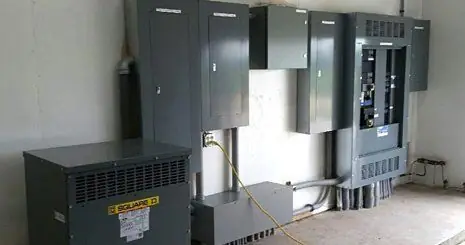
Completed industrial electrical installation with Square D transformer and distribution panels
Calibration and bench testing: meters, controllers, transducers
A process that runs on a pressure transducer, a flow meter or a temperature controller is only as trustworthy as the last time that instrument was actually checked against a known reference, not just visually inspected. Drift in a transducer reads as a process problem long before anyone suspects the instrument itself, because the output still looks like a plausible number, it's just the wrong one. We bench test and calibrate meters, controllers and transducers against known standards, document what we found against what it should read, and correct or replace the instrument rather than nudge a setpoint to compensate for a reading that's already off.
The same discipline applies to automated lighting control panels, which are really just another instrument loop: a photocell or occupancy input feeding a controller that's supposed to switch or dim a zone correctly, and a panel that's fallen out of calibration will either waste energy running lights that should be off or leave a work area under-lit without tripping any obvious alarm.
We also handle fire alarm testing for commercial buildings on the same visit type, since it's the same instinct: verify the system actually does what the panel says it's doing, on a schedule, rather than assuming it still does because nothing has gone wrong yet.
Chapter 03
Lighting retrofits, ballast change-outs and parking lot poles
Most commercial lighting retrofits in Central Wisconsin start with a burned-out ballast that gets replaced one fixture at a time for a couple of years until a shop or a warehouse is running three different lamp types and nobody remembers which ballast goes with which fixture anymore. We retrofit whole buildings at once instead, matching fixtures and drivers so a warehouse or a shop floor lights evenly rather than in patches, and we're a partner of Wisconsin's Focus on Energy program, so a retrofit that cuts a building's energy bill can also qualify for a rebate through that program rather than the full cost sitting on one invoice.
Parking lot poles are their own category of problem, because the failure is usually at the base or in underground feeder wiring, not in the fixture head. We own our own bucket trucks and underground locating equipment, so a dead pole light or a section of a lot that's gone dark doesn't have to wait on a subcontractor with a bucket truck of their own or a locate crew scheduled a week out. Warehouse lighting, storefront lighting and lot lighting all get the same treatment: find the actual fault, fix the wiring it's actually on, not just swap the visible part.
A lot that's gone dark overnight is also a liability problem for the business that owns it, which is usually why the call comes in urgently rather than on a maintenance schedule. We treat it that way.
Code violation corrections before an inspection deadline
A code violation notice on a commercial building almost always comes with a deadline attached, and the corrections it lists are rarely one simple fix. It's more often a mix of things an inspector flagged on one walk-through: an overloaded panel, missing or damaged covers, wiring that was added over the years without permits, or equipment grounding that was never brought up to the current code when the building changed hands. We read the actual violation list, correct each item to what the code requires rather than the minimum that gets a checkbox marked, and document the work so it holds up on re-inspection instead of coming back as a repeat citation.
New construction, additions and remodels get the same standard applied from the start, which is the cheaper way to deal with code compliance: wiring a build-out correctly the first time costs less than correcting it later under a deadline. Panel replacements and upgrades, general maintenance, repair and troubleshooting, and generator backup power systems for a business that can't afford a multi-hour outage all fall under the same shop and the same crew.
Whether it starts as a drive that won't hold speed, a lot light that's been dark for a month, or a violation notice with thirty days on it, it comes out of the same shop on County Highway QQ that's been doing this work since 1957. Call (715) 258-2848 and tell us what the inspector wrote, or what the line is doing; we'll tell you honestly what it takes to fix it.
Bauer Electric — Licensed and insured electrical contractors. Call (715) 258-2848.